Food can dimensions follow a century-old numbering system standardized across the entire USA food supply chain — from home pantries to school cafeterias to FEMA emergency stockpiles. This guide gives you every measurement, every size code, every real-world comparison, and every practical fact you need to understand canned food container dimensions completely and confidently.
Standard Food Can Dimensions Chart (All Sizes)
Can Size
Diameter
Diameter (mm)
Height
Height (mm)
Capacity
Common Foods
211×106
2-11/16″
68 mm
1-6/16″
41 mm
3 oz
Baby food, tomato paste
#1 Picnic (211×400)
2-11/16″
68 mm
4″
101 mm
10–12 oz
Condensed soup, fruit
307×200
3-7/16″
87 mm
2″
51 mm
8 oz
Tomato sauce
#2 Short (307×308)
3-7/16″
87 mm
3-1/2″
89 mm
13 oz
Beans, corn, vegetables
#300
3″
76 mm
4-7/16″
113 mm
15 oz
Soups, vegetables
#303
3-3/16″
81 mm
4-3/8″
111 mm
16–17 oz
Tomatoes, fruit, beans
#2.5 (401×411)
4-1/16″
103 mm
4-11/16″
119 mm
26–28 oz
Sliced fruit, pie filling
#3 Cylinder
4-1/4″
108 mm
4-7/8″
124 mm
46 oz
Fruit juice, tomato juice
#5
5-1/8″
130 mm
5-7/8″
149 mm
56 oz
Institutional soups, chili
#10 (603×700)
6-3/16″
157 mm
7″
178 mm
100–105 oz
Bulk vegetables, sauces
food-can-dimensions-guide
Small Retail Can Dimensions (3 oz, 8 oz, 12 oz, #1 Picnic)
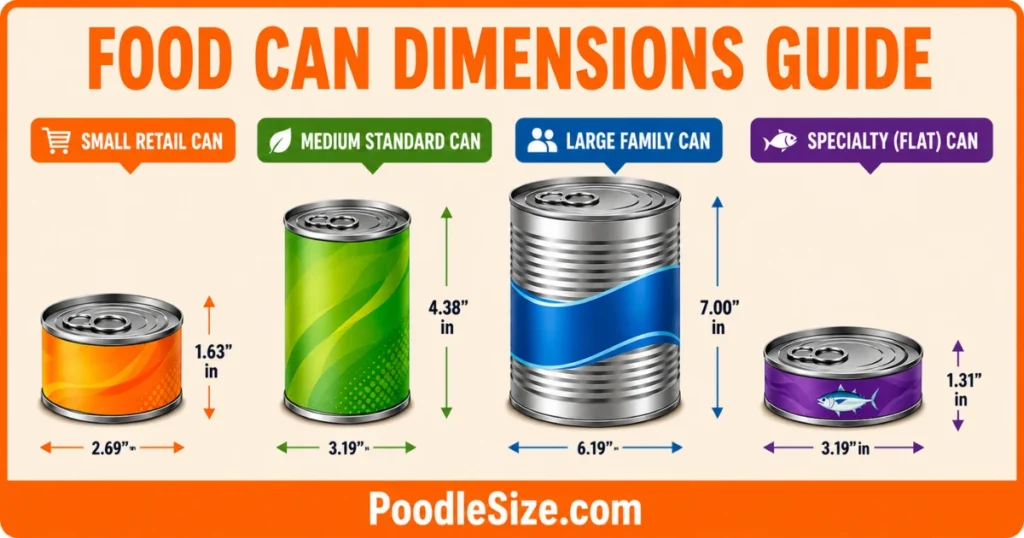
Small retail food cans range from the compact 211×106 can, measuring approximately 1-6/16 inches (41 mm) tall, to the larger #1 Picnic can (211×400), which measures 4 inches (101 mm) tall with a 2-11/16 inch (68 mm) diameter.
These containers have capacities ranging from about 3 oz in the smallest format to 10–12 oz in the #1 Picnic can, providing standardized sizes for single-serve and small household food packaging.
Medium Standard Can Dimensions (#300, #303, #2 Short)
The #303 can measures 3-3/16 inches (81 mm) in diameter and 4-3/8 inches (111 mm) tall, with a typical capacity of 16–17 oz (about 2 cups), making it one of the most common standard food can sizes.
Other popular medium-size formats include the #300 can at 3 inches × 4-7/16 inches with a 15 oz capacity, and the #2 Short can (307×308) at 3-7/16 inches × 3-1/2 inches, holding approximately 13 oz.
Large Family and Commercial Can Dimensions (#2.5, #3, #5, #10)
The #2.5 can (401×411) measures 4-1/16 inches (103 mm) in diameter and 4-11/16 inches (119 mm) tall, with a capacity of 26–28 oz (3.25–3.5 cups), while the larger #3 Cylinder can measures 4-1/4 inches × 4-7/8 inches and holds approximately 46 oz (5.75 cups).
At the upper end of standard food can sizes, the #5 can measures 5-1/8 inches × 5-7/8 inches with a 56 oz (7-cup) capacity, and the #10 can measures 6-3/16 inches × 7 inches, holding approximately 100–105 oz (12–13 cups).
Specialty and Flat Can Dimensions (Baby Food, Tuna, Condensed Milk)
The 211×106 can is one of the smallest standard food can formats, measuring approximately 2-11/16 inches (68 mm) in diameter and 1-6/16 inches (41 mm) tall, with a compact design intended for small-volume food products.
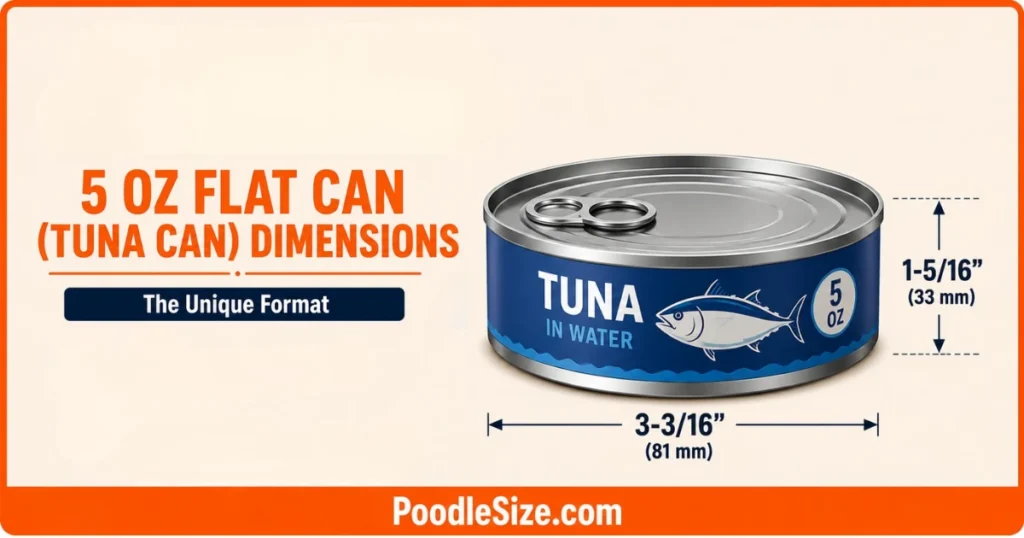
The standard 5 oz tuna can measures 3-3/16 inches (81 mm) in diameter and only 1-5/16 inches (33 mm) tall, giving it a wide, low-profile shape that makes it one of the flattest consumer food containers in common retail packaging.
Detailed Breakdown of Every Major Food Can Size
#10 Can Dimensions — The Institutional Giant
#10-can-dimensions
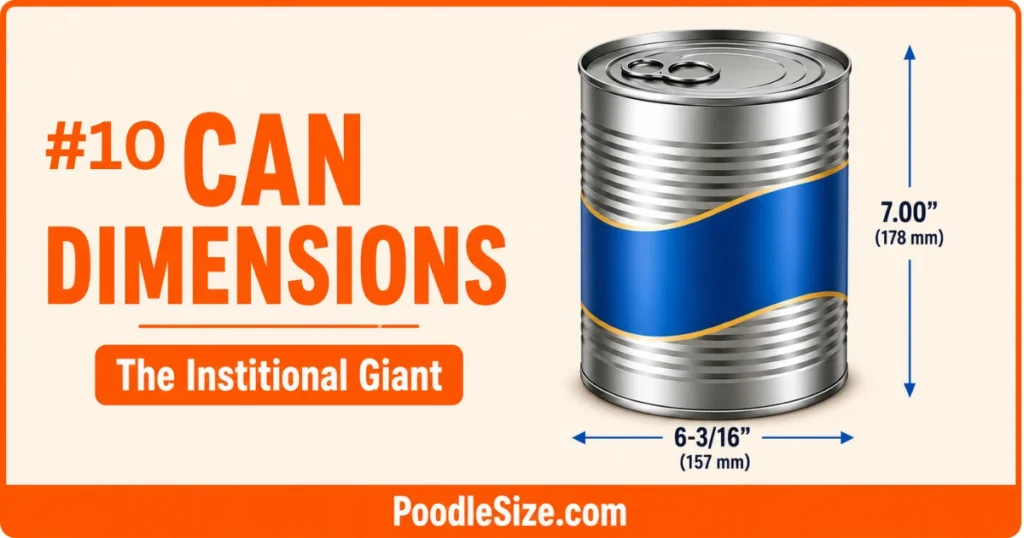
The #10 can (603×700) measures 6-3/16 inches (157 mm) in diameter and 7 inches (178 mm) tall, with a typical capacity of 100–105 fluid ounces (about 2.9 liters or 12–13 cups).
When filled, a #10 can typically weighs around 6 pounds (2.7 kg), making it the largest standard food can size commonly used for bulk storage and commercial foodservice operations.
#303 Can Dimensions — America’s Most Common Grocery Can
#303-can-dimensions
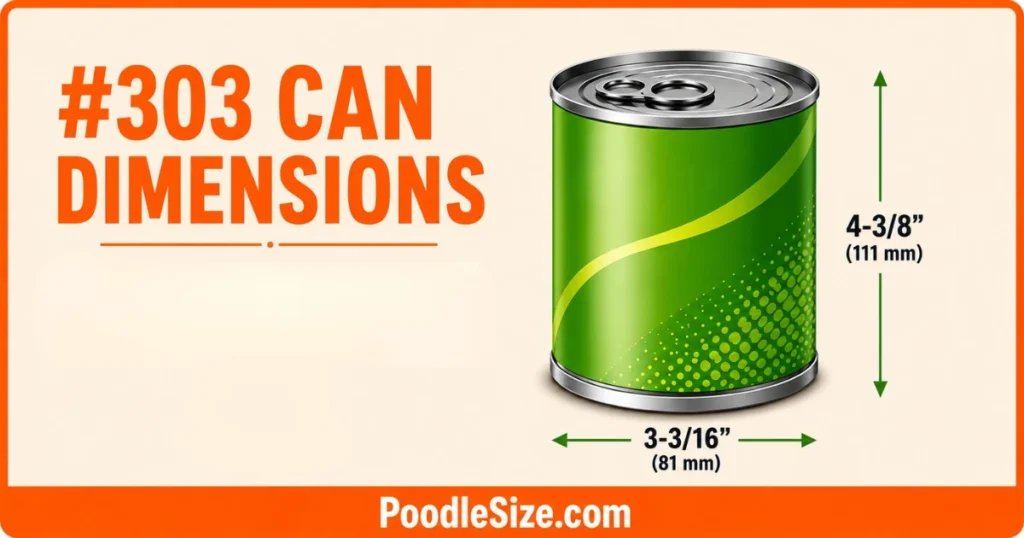
The #303 can measures 3-3/16 inches (81 mm) in diameter and 4-3/8 inches (111 mm) tall, with a typical capacity of 16–17 ounces (approximately 2 cups).
Its standardized dimensions make it one of the most common medium-size food containers, offering a compact footprint while maintaining a relatively high volume-to-size ratio for retail food packaging.
#300 Can Dimensions — The Narrow Cousin of the #303
#300-can-dimensions
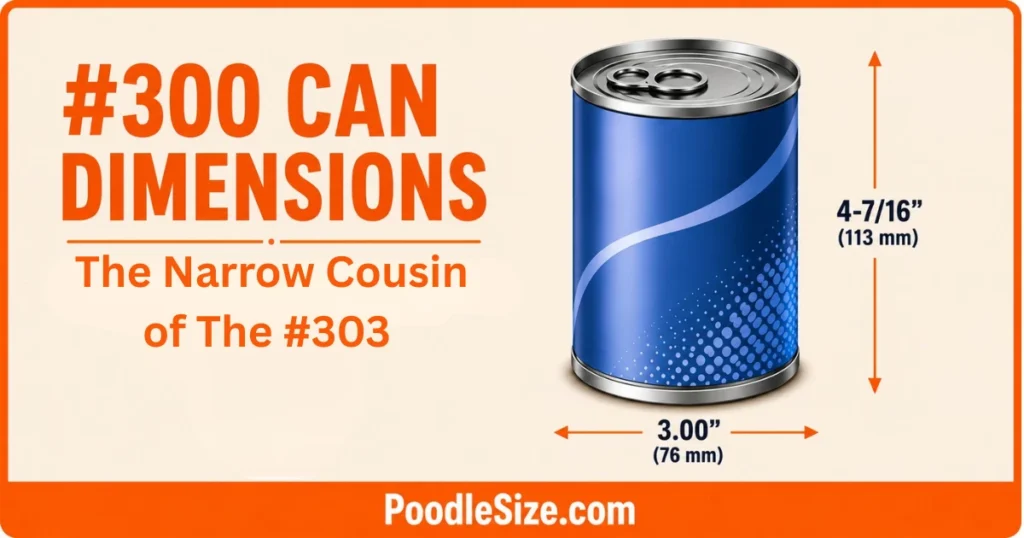
The #300 can measures 3 inches (76 mm) in diameter and 4-7/16 inches (113 mm) tall, with a typical capacity of approximately 15 ounces (1.875 cups).
Compared to the #303 can, it is only 3/16 inch (4.8 mm) narrower in diameter, making the two formats very similar in size while maintaining slightly different volume and dimensional specifications.
#401 Can Dimensions — The Family-Size Standard
#401-can-dimensions
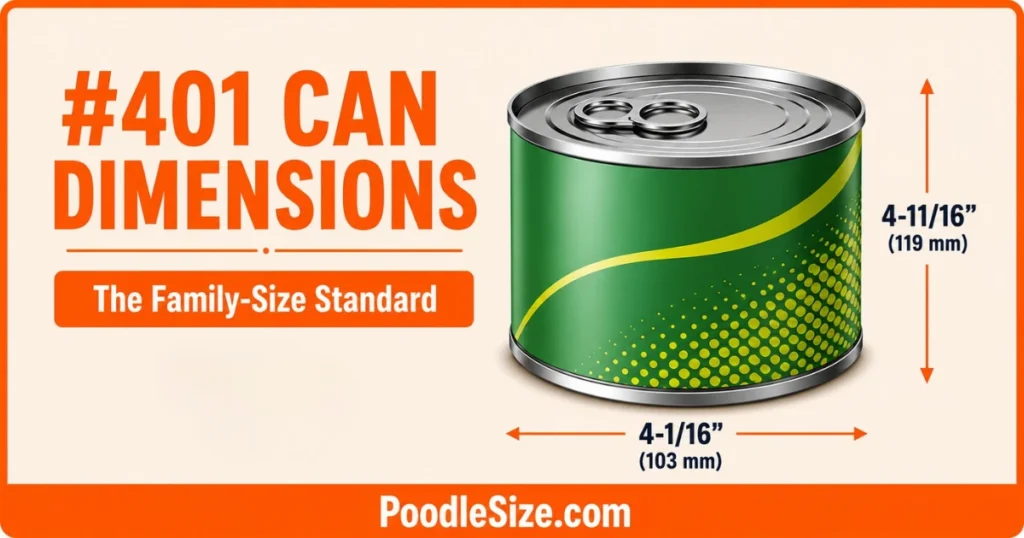
The #401 can measures 4-1/16 inches (103 mm) in diameter and 4-11/16 inches (119 mm) tall, with a typical capacity of 26–28 ounces (3.25–3.5 cups).
Its larger dimensions provide approximately 1.75 times the volume of a standard #303 can, making it a common large-format container for family-size food packaging and bulk ingredients.
15 oz vs 16 oz Can Dimensions — What Is Actually Different?
#15oz-vs-16oz-can-dimensions
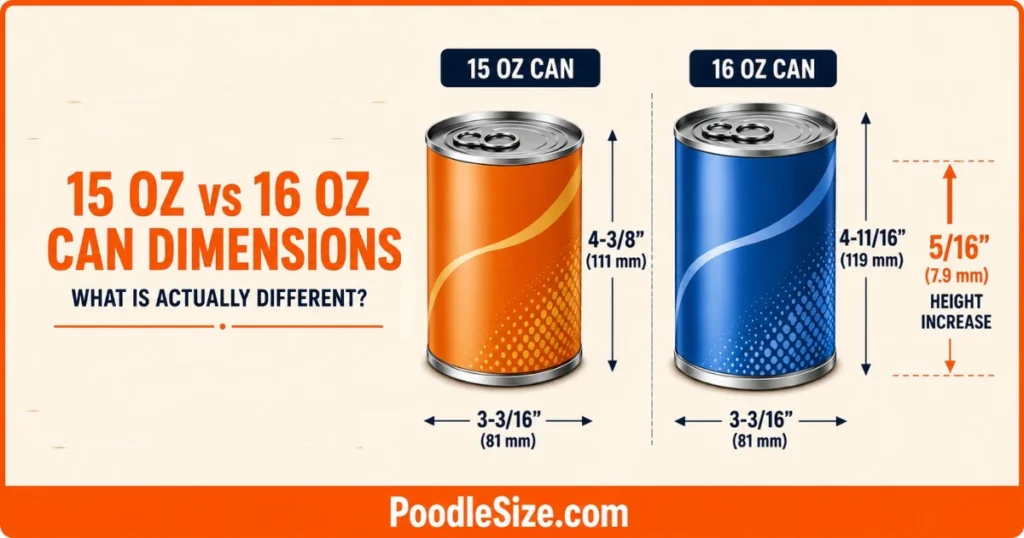
The 15 oz can typically measures 3-3/16 inches (81 mm) in diameter and 4-3/8 inches (111 mm) tall, while a comparable 16 oz can maintains the same diameter but increases in height to approximately 4-11/16 inches (119 mm).
The primary specification difference between these formats is the 5/16-inch (7.9 mm) height increase, which provides the additional internal volume required to hold the extra ounce of product.
28 oz Can Dimensions — The Large Retail Format
#28oz-can-dimensions
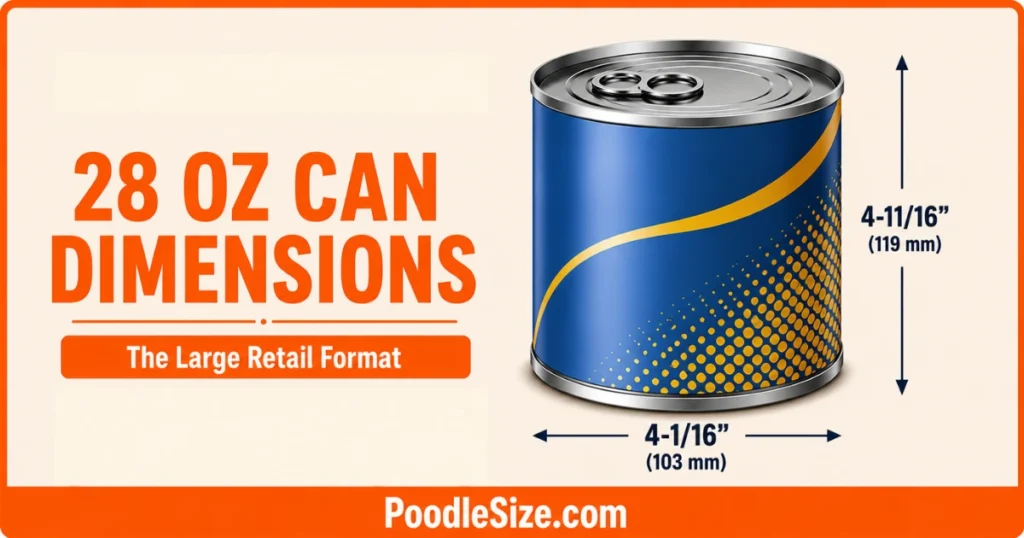
The 28 oz can (#2.5 / 401×411) measures 4-1/16 inches (103 mm) in diameter and 4-11/16 inches (119 mm) tall, with a typical capacity of 28 ounces (approximately 3.25–3.5 cups).
This larger can format typically weighs around 1.75 pounds (794 g) when filled and provides nearly double the volume of a standard #303 can, making it a common choice for family-size food packaging.
5 oz Flat Can (Tuna Can) Dimensions — The Unique Format
#5oz-flat-can-Dimensions
The 5 oz flat tuna can measures approximately 3-3/16 inches (81 mm) in diameter and 1-5/16 inches (33 mm) tall, giving it a wide, low-profile design compared to other standard food can formats.
With a 5-ounce capacity, it is one of the most compact and space-efficient canned food containers, featuring the shortest height among commonly used retail food cans.
8 oz and 14 oz Specialty Can Dimensions
#8oz-and-14oz-specialy-can-Dimensions
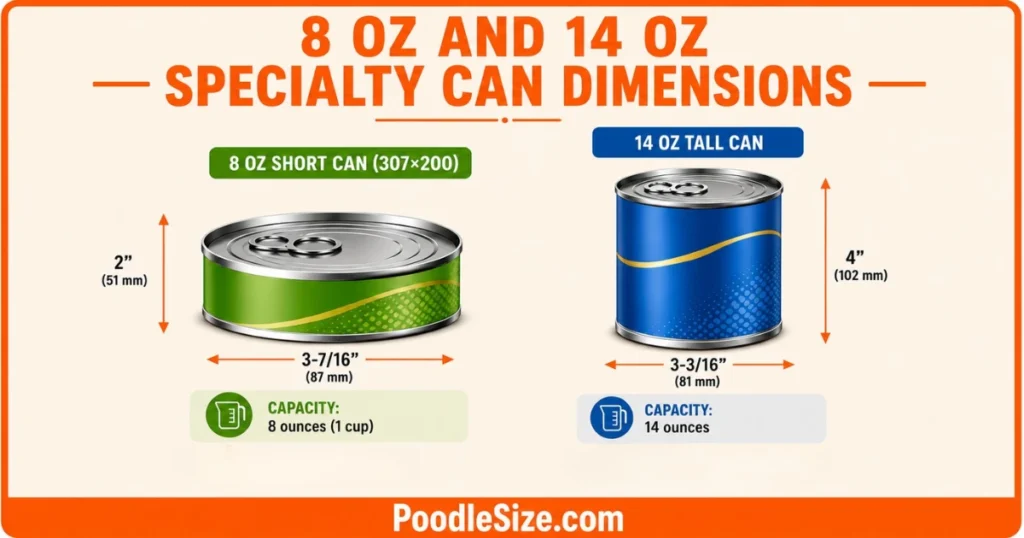
The 8 oz short can (307×200) measures 3-7/16 inches (87 mm) in diameter and 2 inches (51 mm) tall, with a capacity of 8 ounces (1 cup), featuring a wide, low-profile design for compact storage.
The 14 oz tall can measures 3-3/16 inches (81 mm) in diameter and 4 inches (102 mm) tall, holding 14 ounces while maintaining a slimmer footprint and taller profile than short-can formats.
Food Can Volume vs. Weight vs. Shelf Life
Net Weight vs. Drained Weight — Why the Difference Matters
Net weight represents the total weight of everything inside a can, including the food contents and any liquid such as water, brine, or syrup, while drained weight refers only to the solid contents after the liquid is removed.
In many canned foods, the drained weight can be significantly lower than the net weight, making it the more accurate specification for comparing actual food quantity, serving sizes, and usable product volume.
Volume-to-Cup Conversion Chart for Every Can Size
Can Size
Net Weight
Approx. Cups
211×106
3 oz
0.375 cups
8 oz Short
8 oz
1 cup
#1 Picnic
10–12 oz
1.25 cups
#300
15 oz
1.875 cups
#303
16–17 oz
2 cups
#2.5
26–28 oz
3.25–3.5 cups
#3 Cylinder
46 oz
5.75 cups
#5
56 oz
7 cups
#10
100–105 oz
12–13 cups
A #10 can holds the equivalent of 6 to 7 standard #303 cans — a useful conversion when scaling commercial recipes down to home kitchen quantities. For emergency food planning, the rule of thumb is that one #10 can of a protein like canned chicken covers approximately one full day of caloric need for one average adult.
What Canned Food Has the Highest Shelf Life?
Low-acid canned foods typically maintain quality for 2–5 years, while high-acid canned foods generally have a shorter 12–18 month best-quality period due to the effects of acidity on the container’s internal coating.
The most important specification affecting shelf life is the double-seam can seal, as an intact seal helps preserve the contents and maintain the can’s protective storage environment over time.
Foods That Should Never Be Home-Canned
Dairy products, grain-based foods, and pureed pumpkin or winter squash are not approved for home canning because their density and composition can prevent safe, uniform heat penetration during processing.
These food categories have no USDA-approved home canning methods, making them unsuitable for standard canning procedures due to safety and preservation limitations.
Can You Really Eat 100-Year-Old Canned Food?
A properly sealed steel food can creates an airtight, oxygen-free environment that helps preserve food quality and prevents microbial contamination for extended periods when the container remains structurally intact.
The key specifications affecting long-term storage are the can’s double-seam seal integrity, wall condition, and absence of swelling, rust penetration, or seam damage, rather than the age of the can alone.
Do Canned Carrots Go Bad?
Canned carrots are a low-acid canned food with a typical best-quality shelf life of 3–5 years, provided the container’s seal, seams, and metal body remain intact and undamaged.
Over time, the most common changes are texture softening and slight color fading, while the can’s overall safety depends primarily on the condition of the airtight seal and container integrity rather than age alone.
The Only Food That Truly Never Expires
Honey has an exceptionally long shelf life due to its unique chemical composition, including low water activity, acidic pH, and naturally occurring preservation properties that inhibit microbial growth.
Its long-term stability depends on maintaining a sealed, moisture-free storage environment, as increased water content can alter its preservation characteristics and reduce storage longevity.
Can You Eat 500-Year-Old Honey?
Properly sealed honey can remain stable for extremely long periods because of its low moisture content, acidic pH, and natural preservation properties that inhibit microbial growth.
Over time, honey may undergo crystallization, darkening in color, and gradual flavor changes, but these are quality-related characteristics rather than changes to its basic storage stability.
How to Measure a Food Can Yourself and Storage Tips
Step-by-Step: How to Measure Diameter, Height and Circumference
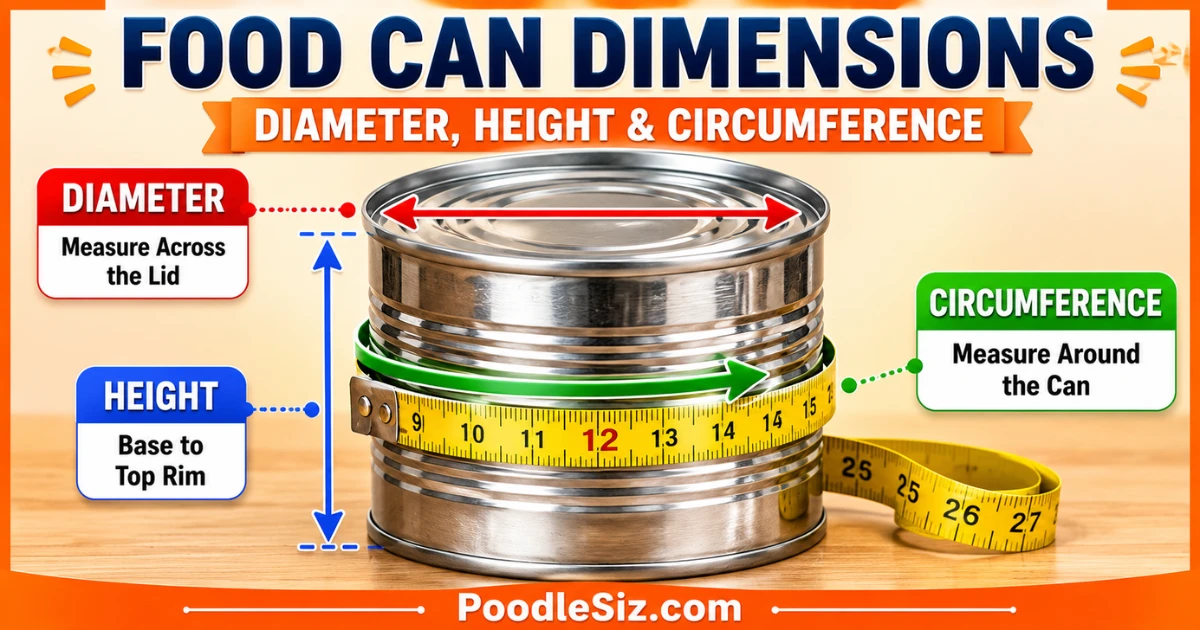
To determine a can’s diameter, height, and circumference, measure across the widest point of the lid, from the base to the top rim, and around the outer body using a flexible tape measure.
These measurements provide the can’s key dimensional specifications, allowing accurate identification of standard can sizes and comparison of container capacities.
Everyday Objects to Compare Against Each Can Size
Common objects can help visualize standard food can dimensions: a #303 can at 3-3/16 inches (81 mm) in diameter is slightly wider than a regulation baseball, while a #10 can at 6-3/16 inches (157 mm) is similar in width to a small personal-size pizza.
Other useful comparisons include the 5 oz tuna can, which is only 1-5/16 inches (33 mm) tall, and the #2.5 (28 oz) can, which measures 4-1/16 inches (103 mm) in diameter, making it noticeably larger than standard retail can formats.
How to Organize Pantry Storage by Can Size
#303 and #300 cans measure approximately 3–3-3/16 inches (76–81 mm) in diameter, allowing multiple cans to fit efficiently on standard pantry shelves and within organizers designed for common retail can sizes.
Larger formats such as the #401 can at 4-1/16 inches (103 mm) in diameter and the #10 can at 7 inches (178 mm) tall require more storage space and are typically best stored on dedicated shelves designed to accommodate their larger dimensions and capacities.
Emergency Food Storage — How Many #10 Cans Do You Need?
Emergency food storage plans often use #10 cans because of their large 100–105 oz (2.9 L) capacity, making them an efficient format for storing substantial quantities of food in a compact space.
A typical #10 can occupies about 0.15 cubic feet of storage volume, allowing multiple cans to be organized efficiently for long-term food storage and household preparedness planning.
Two-Piece vs. Three-Piece Can Construction
Two-piece cans are manufactured from a single metal body with an integrated base, creating only one seam and allowing for highly consistent diameter tolerances and improved structural integrity.
Three-piece cans consist of a rolled cylindrical body with separate top and bottom lids, resulting in three joined components and slightly greater variation in dimensional specifications due to the welded side seam construction.
Steel vs. Aluminum Food Cans — Which Lasts Longer?
Steel food cans typically use wall thicknesses ranging from 0.15–0.30 mm and are designed to withstand the high temperature and pressure requirements of commercial food processing, making them the most common material for canned food packaging.
Aluminum cans are approximately 40% lighter than comparable steel containers and offer natural corrosion resistance, but their different structural properties make them more suitable for applications with lower pressure demands.
FAQ’s About Food Can Dimensions
What size is a standard can of food?
The most standard retail food can in the USA is the #303 can, measuring 3-3/16 inches (81mm) in diameter and 4-3/8 inches (111mm) tall, holding 16 to 17 oz (approximately 2 cups). It is the default format for virtually every canned vegetable, bean, and fruit sold in American supermarkets.
What two foods never expire?
Honey and pure granulated salt are the two foods with scientifically documented indefinite shelf lives in sealed, airtight storage. Honey’s antimicrobial enzyme chemistry and salt’s complete moisture-depriving ionic structure both prevent microbial growth permanently under proper storage conditions.
Is a regular can 12 oz?
In beverage packaging, 12 oz is considered the standard regular can size. In food packaging, the term “regular can” most accurately refers to the 15 to 17 oz #303 format — the most purchased food can size in American grocery stores by annual unit volume.
Why is a #10 can called a #10 can?
The #10 designation comes from a sequential historical numbering system established by early American can manufacturers over 100 years ago. The number refers to its position in the original industry size classification, not to any measurement of ounces, pounds, or physical dimensions.
What is the most common can size?
The #303 can (16 to 17 oz) is the most common food can size in the United States, used for beans, corn, diced tomatoes, green beans, and dozens of other staple products. Americans purchase over 25 billion #303-format cans annually across all food categories combined.
How wide is a normal can?
A standard #303 food can is 3-3/16 inches (81mm) wide in exterior diameter — nearly identical to the width of a regulation baseball. Smaller cans like the #1 Picnic measure 2-11/16 inches (68mm) wide, while the largest standard size, the #10 can, measures 6-3/16 inches (157mm) wide.
Can I eat 100 year old canned food?
A 100-year-old canned food item is technically safe to eat if the can is fully intact — showing no swelling, no seam damage, no rust penetration through the metal wall, and no off-odor upon opening. The hermetic seal, not the calendar age, is the sole determinant of safety in any commercially processed steel food can.
Can you eat 500 year old honey?
500-year-old honey in a hermetically sealed, moisture-free container is microbiologically safe to consume because honey’s antimicrobial enzymatic chemistry remains fully active regardless of age. The practical concern is flavor and texture change from crystallization and Maillard reaction darkening — not any food safety risk.
What is the only food that won’t expire?
Honey is the only food with peer-reviewed, scientifically confirmed indefinite shelf stability under proper sealed storage. Its combination of sub-0.6 water activity, naturally acidic pH 3.2 to 4.5, and continuous hydrogen peroxide production through the glucose oxidase enzyme system makes it permanently inhospitable to all microbial life.
What canned food has the highest shelf life?
Low-acid canned meats — including canned tuna, chicken, and SPAM — hold the highest documented shelf life among commercially canned foods, maintaining peak quality for 3 to 5 years and remaining safe well beyond. Low-acid vegetables like corn, beans, and carrots follow at 3 to 5 years best quality per USDA standard guidelines.
What foods shouldn’t be canned?
Dairy products (butter, milk, cream, cheese), grain-based foods (flour, pasta, rice, bread), and pureed dense vegetables (pumpkin puree, mashed winter squash) should never be home-canned. No USDA-tested, scientifically validated safe process exists for any of these product categories in home canning equipment.
Do canned carrots go bad?
Canned carrots do not go bad while the can seal remains intact — they stay microbiologically safe well past their printed best-by date as a low-acid USDA-classified vegetable. Textural softening and minor color fading occur with age but represent cosmetic quality changes only, not food safety concerns.
Conclusion
From the 1-5/16 inch flat tuna can to the 7-inch institutional #10 giant, every format in the standardized system exists for a specific purpose, audience, portion need, and storage application. Armed with every measurement, every size code, every shelf life fact, and every real-world comparison in this guide, you can now plan smarter, store more efficiently, and make genuinely informed decisions every single time you reach for a can.
Hi, I’m Stella Quinn, the admin at PoodleSize.com. We simplify measurements with quick conversions, easy guides, and real-life size comparisons to help you find accurate answers fast.