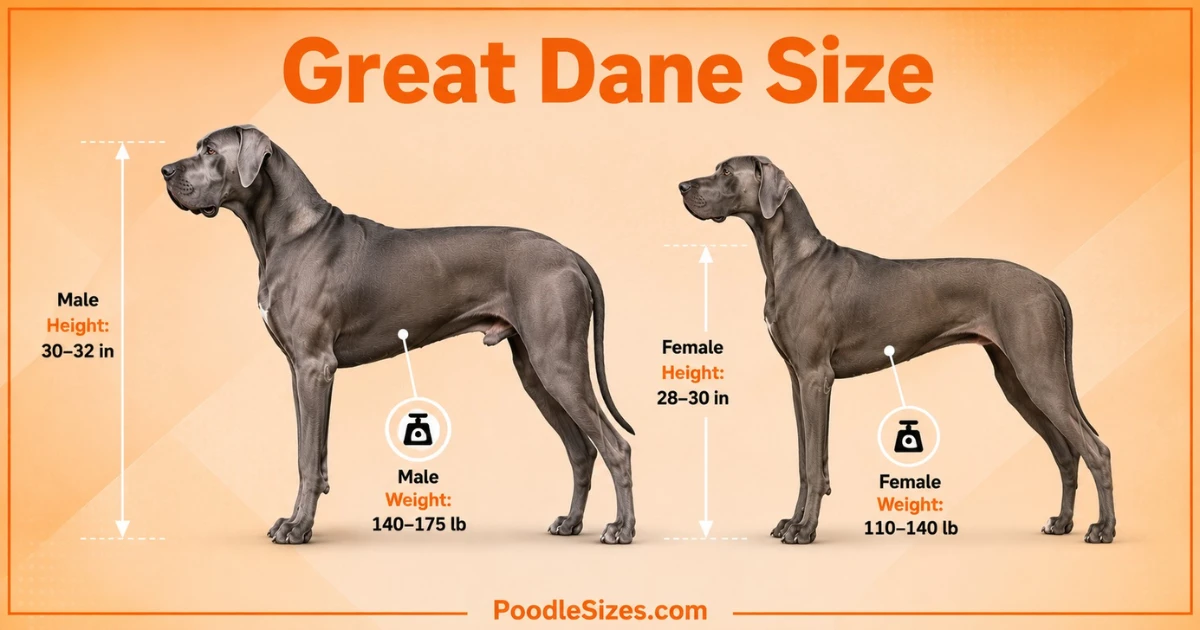
The Great Dane is one of the tallest dog breeds in the world, with adult males typically standing 30 to 32 inches (76 to 81 cm) at the shoulder and weighing 140 to 175 pounds (64 to 79 kg). Females run slightly smaller, usually 28 to 30 inches (71 to 76 cm) tall and 110 to 140 pounds (50 to 64 kg).
This guide breaks down everything that affects Great Dane size, from official breed standard measurements to a month-by-month growth chart, so you know exactly what to expect as your dog grows.
Great Dane Size Overview
Average Great Dane Size at a Glance
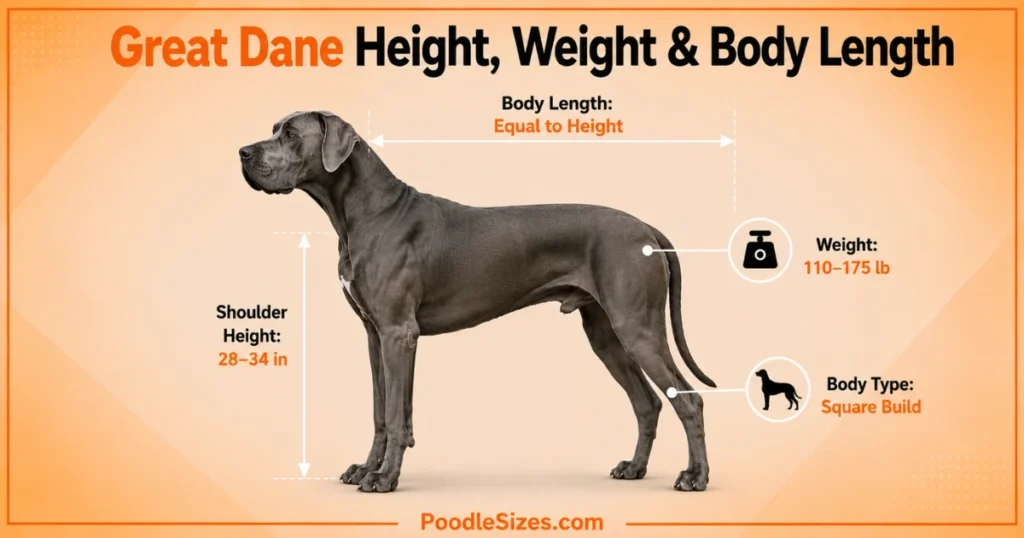
A full-grown Great Dane typically stands between 28 and 34 inches (71 to 86 cm) at the shoulder and weighs between 110 and 175 pounds (50 to 79 kg), depending on sex and build. Despite this massive frame, Great Danes are classified as a giant breed with a relatively short lifespan of 7 to 10 years, a trade-off common in dogs this large.
Great Dane Breed Standard Size (AKC)
The American Kennel Club breed standard sets minimum height requirements rather than a fixed range: 30 inches at the shoulder for males and 28 inches for females. There is no official maximum, since taller dogs that maintain correct proportion and structure are not penalized. The AKC standard does not specify an exact weight; the commonly cited weight ranges come from veterinary and breed-club data rather than the written standard itself.
Minimum & Maximum Great Dane Size
Any male under 30 inches or female under 28 inches falls below the breed standard minimum, though these dogs are still healthy Great Danes. On the upper end, some individuals exceed 34 inches, and record-holding dogs have measured over 40 inches at the shoulder, well beyond typical breed expectations.
Great Dane Shoulder Height (Standing Height)
Shoulder height, also called standing height or withers height, is measured from the ground to the highest point of the shoulder blades while the dog stands on all four legs. This is the standard measurement used in breed standards and at dog shows, and it’s different from a dog’s height when reared up on its hind legs.
Great Dane Weight Range by Build
Great Dane weight varies more than height because it reflects muscle mass and bone density, not just frame size. A lean, athletic Great Dane may sit at the lower end of the weight range, while a heavier-boned dog of the same height can weigh 20 to 30 pounds (9 to 14 kg) more. Body condition matters more than the number on the scale — ribs should be easily felt but not visibly prominent.
Great Dane Body Length & Proportions
Great Danes are considered a square breed, meaning body length (from the point of the shoulder to the point of the rump) is roughly equal to height at the shoulder. This balanced proportion is part of what gives the breed its elegant, powerful silhouette rather than the elongated look seen in breeds like Dachshunds or Basset Hounds.
More Posts: Cane Corso Size: Full-Grown Height, Weight and Growth Chart
Male vs. Female Great Dane Size

Male Great Dane Size (Height & Weight)
Adult male Great Danes typically stand 30 to 32 inches (76 to 81 cm) at the shoulder and weigh 140 to 175 pounds (64 to 79 kg). Males also carry noticeably more bone mass and a broader head and chest, giving them a heavier, more imposing frame than females of the same height.
Female Great Dane Size (Height & Weight)
Adult female Great Danes generally stand 28 to 30 inches (71 to 76 cm) tall and weigh 110 to 140 pounds (50 to 64 kg). Females mature slightly earlier than males and tend to have a leaner, more refined build.
Why Male and Female Great Danes Differ in Size
This size gap comes down to sexual dimorphism, a trait common in most dog breeds. Males carry more muscle mass and skeletal density due to hormonal differences, which is why the AKC standard sets a two-inch gap between minimum male and female height requirements.
Great Dane Growth Chart: Puppy to Full-Grown

Great Dane Puppy Size by Age
Great Dane puppies gain size faster than almost any other breed. Approximate growth milestones look like this:
- 2 months: 15–25 lbs (7–11 kg), 12–17 in (30–43 cm)
- 3 months: 25–40 lbs (11–18 kg), 16–22 in (41–56 cm)
- 4 months: 40–60 lbs (18–27 kg), 20–25 in (51–64 cm)
- 6 months: 65–100 lbs (29–45 kg), 26–32 in (66–81 cm)
- 9 months: 85–125 lbs (39–57 kg), 28–34 in (71–86 cm)
- 12 months: 100–140 lbs (45–64 kg), 29–35 in (74–89 cm)
These figures are general estimates. Individual puppies vary based on genetics, sex, and nutrition, so a puppy running slightly above or below these numbers isn’t necessarily a concern.
When Are Great Danes Fully Grown?
Most Great Danes reach their full height by around 18 months old, but they continue adding muscle, chest depth, and overall mass until roughly 2 to 3 years of age. This slow physical maturation is typical of giant breeds, whose growth plates stay open longer than those of small or medium dogs.
Factors That Affect Great Dane Growth
Genetics is the biggest factor — a puppy’s adult size closely tracks its parents’ size. Nutrition matters too: large-breed puppy food formulated for slower, controlled growth helps protect developing joints and reduces the risk of hip dysplasia. Spaying or neutering before growth plates close has also been linked in veterinary research to slightly taller, leaner adult frames, since sex hormones influence when growth plates seal.
Great Dane Size Comparison

Great Dane vs. Other Giant Dog Breeds
Compared to other giant breeds, Great Danes stand out for height rather than bulk:
- Great Dane: 28–32 in (71–81 cm), 110–175 lbs (50–79 kg) — tallest of the giant breeds
- Irish Wolfhound: 30–32 in (76–81 cm), 105–180 lbs (48–82 kg) — similar height, leaner build
- English Mastiff: 27–30 in (69–76 cm), 130–230 lbs (59–104 kg) — shorter but far heavier
- Saint Bernard: 26–30 in (66–76 cm), 120–180 lbs (54–82 kg) — shorter and stockier
- German Shepherd: 22–26 in (56–66 cm), 50–90 lbs (23–41 kg) — included for everyday scale reference
The Largest Great Dane Ever Recorded

The tallest dog ever officially measured was Zeus, a Great Dane from Michigan, who stood 44 inches (111.8 cm) at the shoulder before his death in 2014. As of early 2025, the Guinness World Record for tallest living male dog belongs to Reggie, a Great Dane from Idaho, measuring 3 feet 3 inches (1.007 m).
The tallest living female title has been held by Great Danes as well, underscoring how consistently this breed dominates the record books. These titles change hands periodically as new dogs are measured and verified.
Great Dane Size FAQs
How big do Great Danes get?
Adult Great Danes typically stand between 28 and 32 inches (71 to 81 cm) at the shoulder and weigh between 110 and 175 pounds (50 to 79 kg), with males larger than females on average.
What is the average height of a Great Dane?
The average height is about 30 inches (76 cm) at the shoulder for males and 29 inches (74 cm) for females, though many individuals fall slightly above or below this depending on genetics.
What is the average weight of a Great Dane?
Most adult Great Danes weigh between 110 and 175 pounds (50 to 79 kg). Males average around 150 to 160 pounds (68 to 73 kg), while females average closer to 120 to 130 pounds (54 to 59 kg).
At what age is a Great Dane fully grown?
Great Danes reach full height by about 18 months but continue filling out with muscle and mass until 2 to 3 years of age.
How much bigger will my Great Dane puppy get?
If your puppy is under 18 months, expect continued height gain, and if under 2 to 3 years, expect ongoing weight and muscle development even after height levels off.
Are male Great Danes bigger than females?
Yes. Males are typically 2 to 4 inches (5 to 10 cm) taller and 20 to 40 pounds (9 to 18 kg) heavier than females, with a noticeably broader build.
What is the tallest Great Dane on record?
Zeus, from Michigan, holds the record for tallest dog ever at 44 inches (111.8 cm). Guinness World Records periodically certifies new tallest-living titleholders, many of which have also been Great Danes.
Do Great Danes stay big forever, or do they slow down growing?
Growth is fastest in the first six months, slows significantly after 12 months, and largely stops by 2 to 3 years, at which point the dog maintains its adult size for the rest of its life.
Is my Great Dane puppy growing too fast?
Rapid growth combined with visible joint strain, limping, or reluctance to move can signal a problem. Large-breed puppy food and controlled exercise help manage healthy growth speed, and a veterinarian should evaluate any puppy showing signs of joint discomfort.

Hi, I’m Stella Quinn, the admin at PoodleSize.com. We simplify measurements with quick conversions, easy guides, and real-life size comparisons to help you find accurate answers fast.